Your comments
As written there seems to be two interpretations of this problem: a traditional cannon that will need to clear the hill and a cannon shooting the cannonball along the ground to fly off the hill. Since the first interpretation would require the angle of the cannon, which is not given, and would not need an exact function for the hill, I will assume the second interpretation. If the first interpretation is correct, this should just be solely a kinematics problem with a minimum angle necessary.
This problem is best solved by working backwards. With some basic calculus, you can determine the angle the cannonball will be launched at when it flies off the hill. Using this angle and the distance from this point to the general (it won't be 100m), you should be able to find the velocity need to hit the general directly. Since this point is at the same height as the general, you can simply use the Range equation. Now that you have a velocity at the top of the hill's slope, you can use conservation of energy to determine the velocity at the bottom of the slope, which should be your initial velocity.
The first thing that you need to do is determine equivalent resistance of the two resistors in parallel (you should be able to easily find how to add resistors in parallel in your textbook). With this, you can determine the voltage drop through both sections, remember that voltages are proportionally distributed to resistors in series and the currents are equal. This should be enough to determine the power dissipated in R1. For R2 and R3, you will have to use the voltage through the equivalent resistor and remember that resistors in parallel must have equal voltage. (Also you mention that you know how P, I, and V relate, but just in case you don't know how R fits in I propose you use incorporate Ohm's law into this relationship).
With the information given it is not clear how the problem expects you to find the centripetal force. When working in polar coordinates, the most common method of obtaining the centripetal force is to use the angular velocity (change in theta with time),omega, with the radius R to obtain the centripetal force using F=m*omega^2*R. As written, the problem does not have enough information to find the centripetal force (I assume that "y=Rcos(theta)" was a typo as that should be sin instead of cos).
While the kinetic energy does increase, conservation of energy is not violated even if it may not be immediately obvious as to why. A more relatable situation might be a student spinning in a desk chair. If they begin with their arms and legs outstretched and then bring them in, their angular velocity will increase. Just like the star this will also increase their kinetic energy even though there does not seem to be a place this energy comes from. The reason why this occurs is because the student expends energy to bring in their arms and legs, thus doing work on the system. The hidden source of energy for the star will likely not be the explosion, as this would make the system lose energy and would have little angular effect. Rather, it is a decrease in gravitational energy. When the star becomes a neutron star, it packs much more mass into a smaller space, this means the mass that was further out had to "fall" towards the center in the transition to a neutron star. This "falling" led to an increase in kinetic energy, specifically rotational kinetic energy.
I think you will find it helpful to first check your lectures notes and the textbook for information on dielectrics. If you're having trouble finding the section in your textbook, keep in mind you can always use the index!
After you know how a dielectric affects a capacitor, think about which of those three quantities are able to be changed. Do you know of a conservation law that applies to one of them (i.e. because the battery has been disconnected)? Once you've figured out which of these quantities definitely cannot change, look for a formula that relates all three quantities.
If you need some more specific help, please don't hesitate to ask!
The first thing to do with almost any problem is to draw a diagram. For this problem, the use of cardinal directions tell us that drawing this on a Cartesian plane would be the best fit.
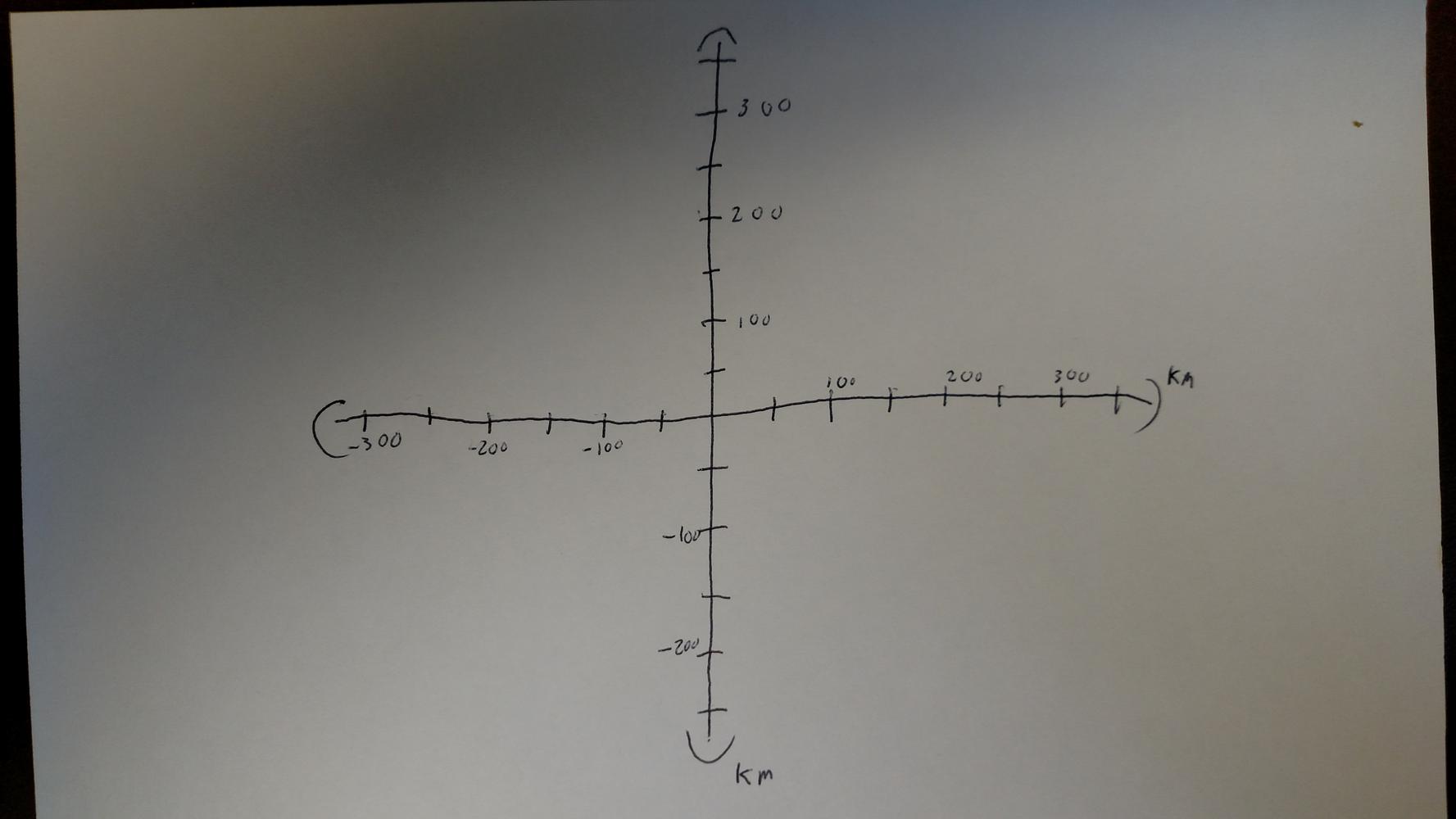
While diagrams do not always have to be to scale, it can often help with the visualization and the fairly normal numbers in this problem allow us an fairly simply scale (remember to put in units!).
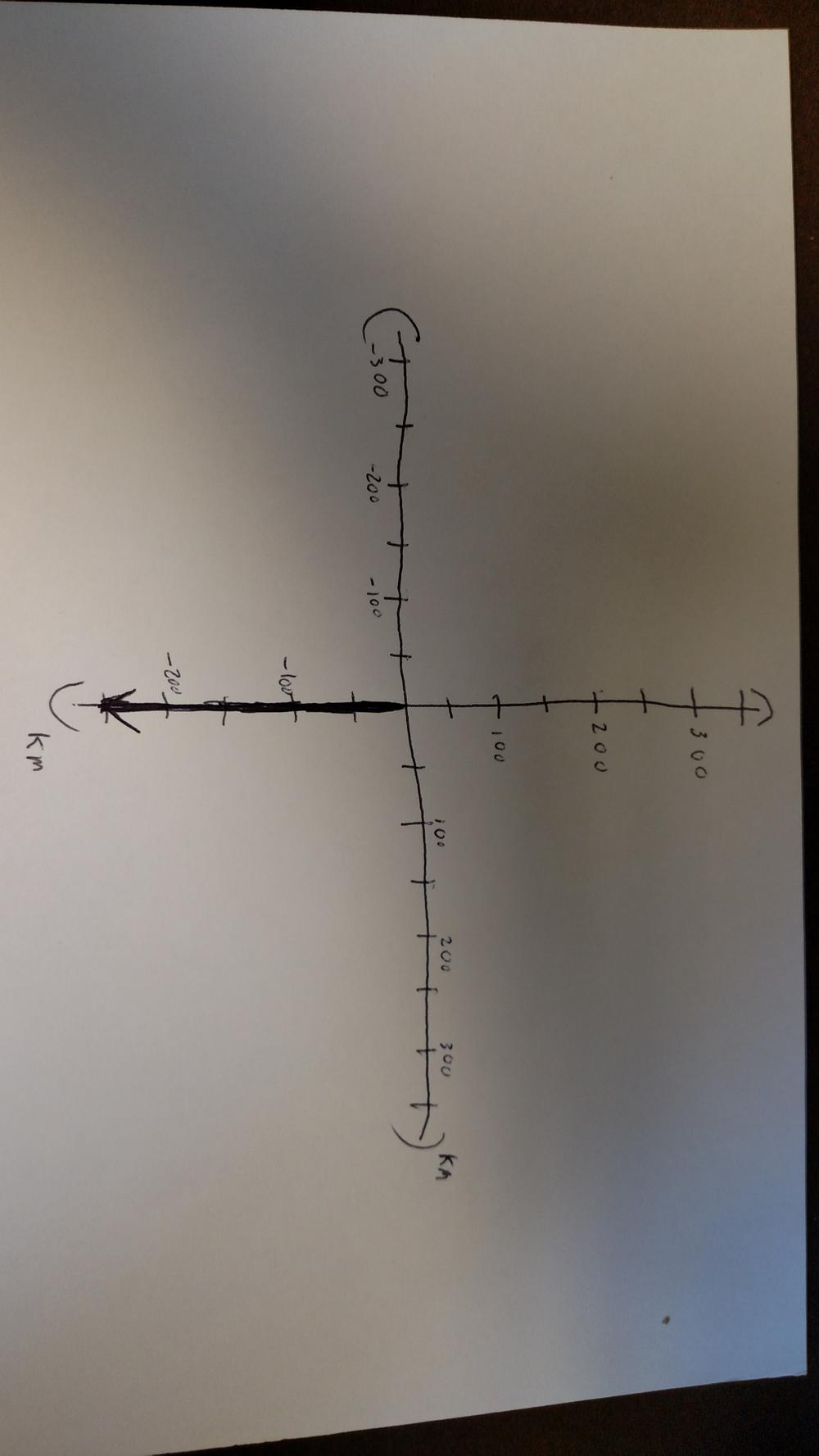
The next step is to simply add each piece of the problem one by one. It is very important to not make any assumptions about the diagram and to simply transcribe only what the problem says. So first we know that the plane was headed due south at 250 km/h, so in one hour the plane should be 250 km south. (Forgive the rotated picture, no matter how I changed the files rotation it would copy in like this)
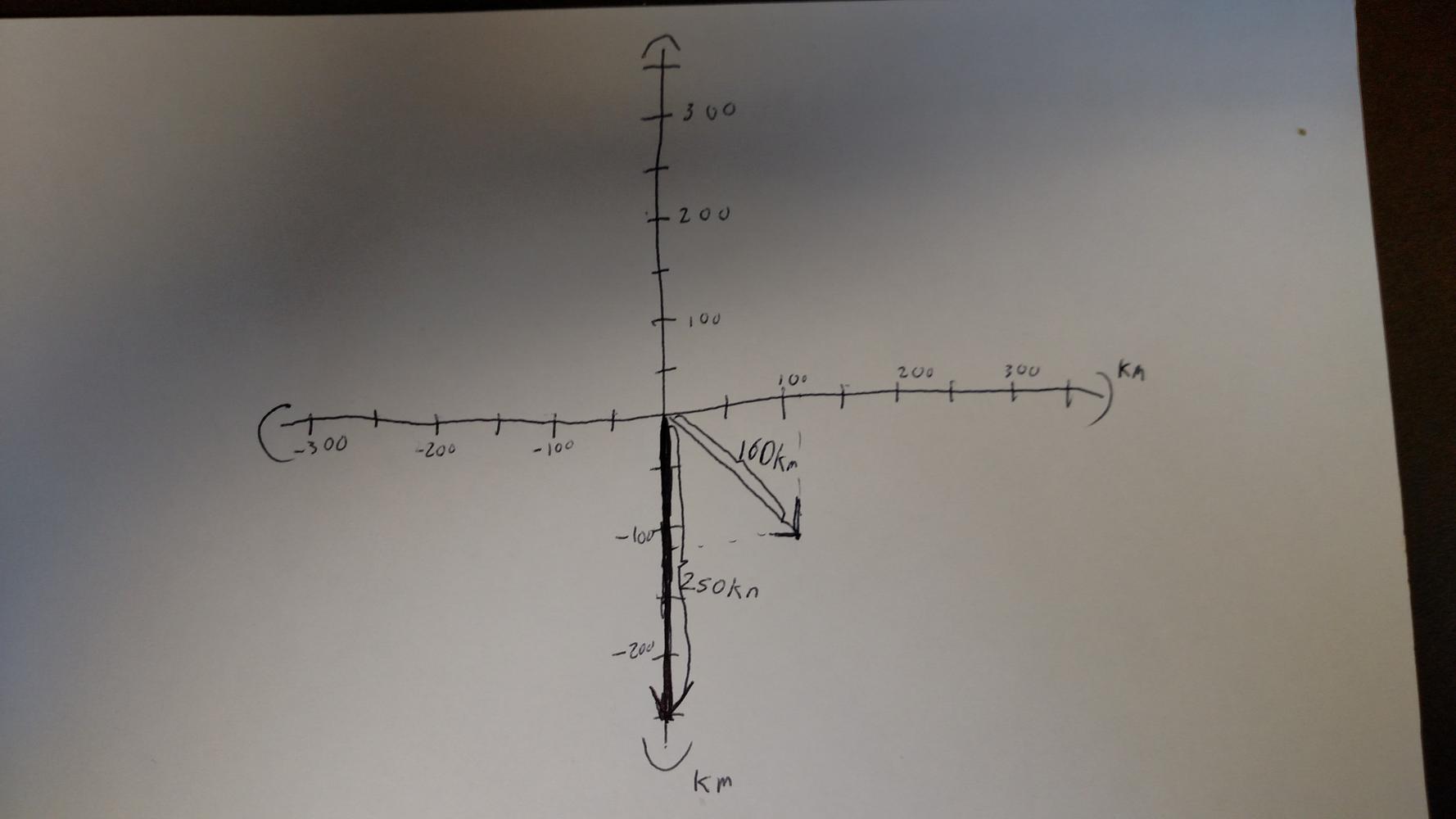
Next we know that the actual distance we covered was 160 km southeast. Here I tried to be a bit meticulous in drawing it and use the x and y components of the distance to keep it to scale. I will leave the exact calculation of these components to you.
So now we have our expected path and our actual path, but we want to find the strength and direction of the wind that caused this difference. The wind was pushing the plane constantly for the entire hour, so we can draw the distance caused by the wind by drawing a vector from our expected destination to our actual destination.
(If it makes it easy to conceptualize, you can change the displacements into velocities by simply dividing by 1 hour. This way what we are actually solving for is the velocity of the wind that, when added to the velocity caused by the plane, causes the actual velocity)
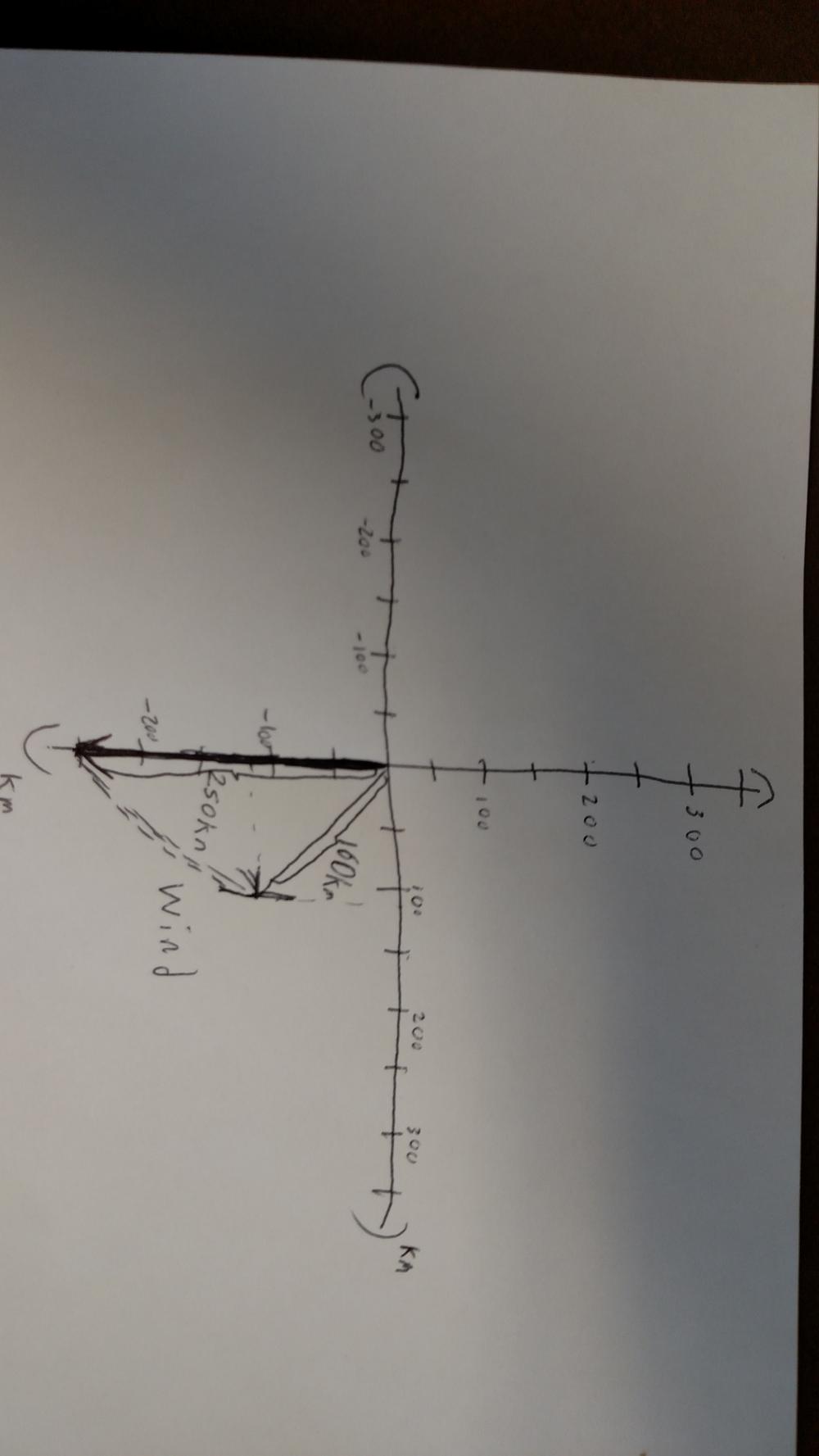
(Once again ignore the rotation)
From here you have two known vectors and an unknown third that you can create using the two knowns, though be careful on how you create the wind vector from the two known vectors.
This problem will need to be split into two parts, calculating the voltage generated and then using the voltage to calculate the average power.
To calculate the voltage generated at a time t for a coil, you need to use the formula
V = 2 pi f N A B sin(2 p f t)
Using the rpm (f), the turns (N), the area (A), and the field (B).
Once you have an expression for V, you can substitute it into a an equation for P. If you can't find one that only uses V and R, you can use Ohm's Law to exchange the variables.
Self-inductance (L) of a solenoid is a fairly straightforward formula.
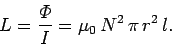
You just need to input your variables for turns or loops (N), radius (r), length (l). Don't forget to use SI units to get the proper value in henrys.
It sounds like the issue might be in how you are adding and subtracting the forces, though your wording is a bit ambiguous as to your exact approach. Looking ahead in the problem, it seems that constructing a full force diagram of the system might be necessary. While this could be complicated and tedious for this particular problem, part c) will be easy to mess up without it.
For part a), the diagram should let you see the directions of the forces (that don't cancel out internally) and add them accordingly. If you want to avoid doing the diagram for now, I recommend thinking about what conceptually should be pushing the sled forward and what should be pulling it back and basing your math on that. Also, make sure you are using the correct coefficient of friction.
If none of this helps, upload a picture of your work so that I can better understand where the issue might lie.
Customer support service by UserEcho


When you have a capacitor in a DC circuit, current will flow until charge builds up on the capacitor and the system reaches its steady state. Notice that the capacitor is in parallel with the resistor and Vout, so all three must have the same potential difference across each other.
In steady state, this voltage difference is constant which means no current flows in or out of the capacitor and also that Q is constant. Using the knowledge that the current through the capacitor is zero, you can essentially take it out of the problem and solve the problem as if it only had a voltage supply and the two resistors.