
How to use Kirckoff's law for this circuit?
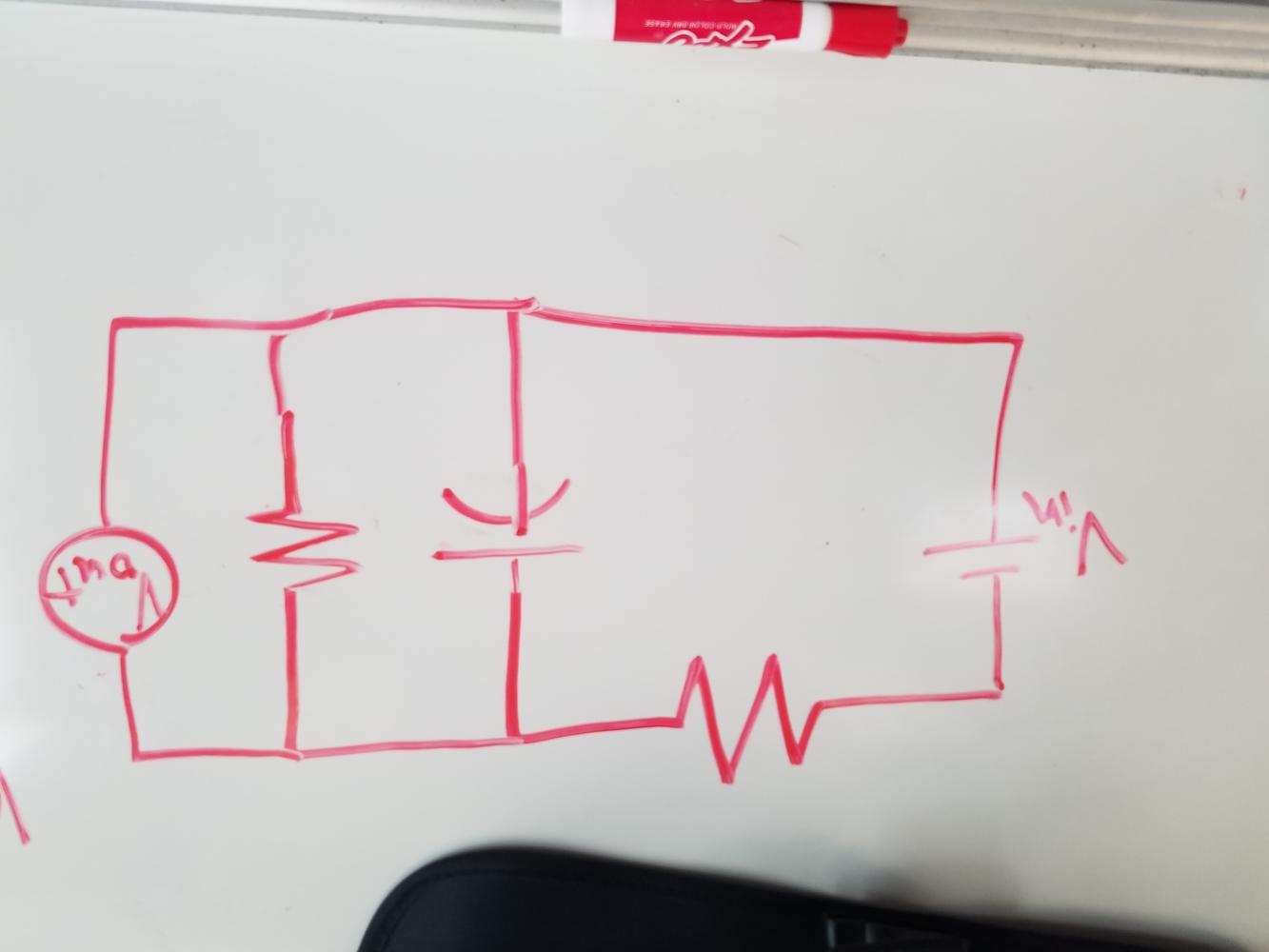
I apologize for the upside down image. However, I am use to using only resistors to find the total potential of the circuit. Here, however, do I also need to use V_capacitor = Q / C ? Note: The two resistors in the circuit are identical ones.
Answer
When you have a capacitor in a DC circuit, current will flow until charge builds up on the capacitor and the system reaches its steady state. Notice that the capacitor is in parallel with the resistor and Vout, so all three must have the same potential difference across each other.
In steady state, this voltage difference is constant which means no current flows in or out of the capacitor and also that Q is constant. Using the knowledge that the current through the capacitor is zero, you can essentially take it out of the problem and solve the problem as if it only had a voltage supply and the two resistors.
Customer support service by UserEcho


When you have a capacitor in a DC circuit, current will flow until charge builds up on the capacitor and the system reaches its steady state. Notice that the capacitor is in parallel with the resistor and Vout, so all three must have the same potential difference across each other.
In steady state, this voltage difference is constant which means no current flows in or out of the capacitor and also that Q is constant. Using the knowledge that the current through the capacitor is zero, you can essentially take it out of the problem and solve the problem as if it only had a voltage supply and the two resistors.