Your comments
The time constant appears in all the formulas for the charge, current, and voltage of a capacitor over time while it is charging or discharging. It appears within the exponential e^(-t/RC).
In the case of a capacitor discharging, the time constant is the amount of time required for the the voltage and charge to be reduced by a factor of 1/e. This might seem strange, but it's the characteristic way to measure the decay time when an exponential is involved.
Basically, it's a measure of how slowly the capacitor will charge or discharge.
The power dissipated through a resistor is P = V^2/R. You're right about the voltage being the same across all the resistors in parallel, but each resistor dissipates its own amount of power V^2/R. So the total power dissipated will increase.
Another way of looking at the situation is to treat all the resistors as a single resistor with an equivalent resistance. In parallel, the inverses of resistances are summed
1/R_effective = 1/R1 + 1/R2 + ...
If you plug in some values and solve for the effective resistance R_effective, you'll see that it has decreased. So the total power P = V^2/R_effective will thus increase.
Current is the same through each element in series, however this current will change depending on what is in the circuit. When resistors are in series, they have the same effect on current as if they were all replaced by one resistor with R= sum( individual resistances ).
A battery has a defined output voltage. The voltage drop across the circuit must equal the voltage of the battery.
Since V= IR, if the total resistance increases(by adding more lights), the current must decrease(and the brightness of each light decreases).
Hope this helps!
Notice that the power supply is AC, alternating current. The equation you provided, P = V^2/R gives the instantaneous power, or the power dissipated at any given moment in time. However, the voltage V is oscillating, or changing with time! To find the average power in an AC circuit you need to use the RMS voltage.
Using energy is a good idea, but as with all physics problems there are many places you could go wrong. First, did you draw a picture of the situation? You will want to define your coordinate system and choose your height h = 0 where the gravitational potential energy is zero. The ground would be a good place to choose because you can draw it on your diagram!
Next, from what height is the projectile starting while it is loaded back into the spring? Does it start at h = 0, meaning it is stretched all the way to the ground? It looks like you may have plugged in the y-component of x, which is not the same situation.
Also, you said that you set the kinetic energy equal to zero at the top of the projectile's curve. However, if the projectile is fired at an angle it will always be moving horizontally even though it reaches a peak height, so there will always be some kinetic energy. Instead, you might try finding the velocity at which the projectile leaves the spring and treat it as a kinematic problem from that point onward.
Your strategy might give you an intuitive answer, but the problem is that you don't know about the interaction forces. Instead, let's try another approach by drawing a diagram and drawing the forces on each individual block.
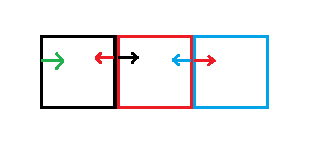
The left-most block has the applied force (green) pushing it to the right, but the normal force with the second block pushing against it. The middle block has two normal forces on it, one pushing it (black) and one opposing it (blue). The rightmost block only has one force acting on it, the normal force due to the middle block (red).
You know that all three blocks will have the same acceleration, so you can use Newton's 2nd law for each block to make an equation in terms of the forces on it and the acceleration. Is there anything else we can determine about this problem? Think about what Newton's 3rd law tells you: each pair of normal forces must be equal and opposite.
Starting with the rightmost block: do you have an expression for the normal force (red arrow)? Can you solve the middle block's equation knowing that the left-facing normal force (blue) is equal and opposite? Try working your way backwards to the original applied force which will let you solve for all of the interaction forces.
First, try drawing a diagram of the situation.:
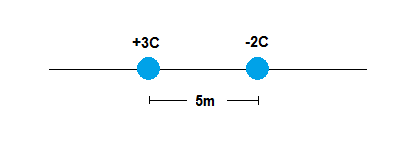
You're right about having three regions on the line that the charge could go. First, think about a few conceptual questions:
1. Is the force on a positive charge due to a positive charge attractive or repulsive? What about due to a negative charge?
2. Does the force get weaker or stronger the closer the charges are to each other?
3. Does a bigger charge make the force weaker or stronger?
With those concepts in mind, imagine placing the +1 C charge in each region. Try answering the above questions for the force due to each charge on the imaginary +1 C charge. Do the two forces oppose each other, or point in the same direction? If they oppose, will one always win no matter where you place it? Try to determine the location that the forces oppose each other, but can be balanced so as to cancel out. Once you know where it is approximately, use Coulomb's Law for both charges and calculate the position that the forces cancel.
First, remember that force is a vector and thus has both direction and magnitude, so it's not sufficient to find one force and multiply it because each force points in a different direction. You must add the force vectors individually.
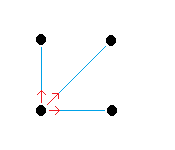
Take a look at this diagram of the situation. Notice that the distance between the masses in opposite corners is greater than the adjacent corners. (Can you figure by how much using geometry?) So there are actually two different distances to use, which means there are two different magnitudes of force to compute.
Try computing the magnitude of the forces between adjacent masses and opposite masses, then adding directions to create the three force vectors (drawn in red on the diagram).
Electric flux is the amount of electric field flowing perpendicular through an area. For a volume, the total flux is the sum of all the electric flux flowing in or out of each surface.
For this problem, first think about what the flux would be if the electric field was constant. The same amount of field would flow through one side of the cube as it would flow out of the opposite side, so the flux would be zero.
If the field is non-constant, one side will have more flux in or out than the other. How much more will depend on how the field changes with position and the length of the cube. If you could provide more information on this problem, we can give you more specific guidance.
Customer support service by UserEcho


First, start with a definition of angular velocity: the change in angle over the change in time. In other words, the angular velocity refers to how fast something is spinning. All three points make one full revolution (360 degrees) in the same amount of time, so their angular velocities must be the same.
An object on a merry-go-round travels in a circle and thus must have a centripetal force acting on it, which points radially inwards and keeps it going in a circle. The centripetal force is F = m r ω^2, where m is the mass, r is the radius, and ω is the angular speed. Like you said, A is at twice the distance of B and C so the force IS greater and it IS actually moving faster even though the angular speeds are the same!
To understand why, remember the relation between tangential velocity and angular velocity:
v = ωr
For the same angular speed, an object at a greater radius will have a faster tangential speed; it has a larger circumference to cover in the same amount of time! I hope this helps clear up the difference between velocity and angular velocity.